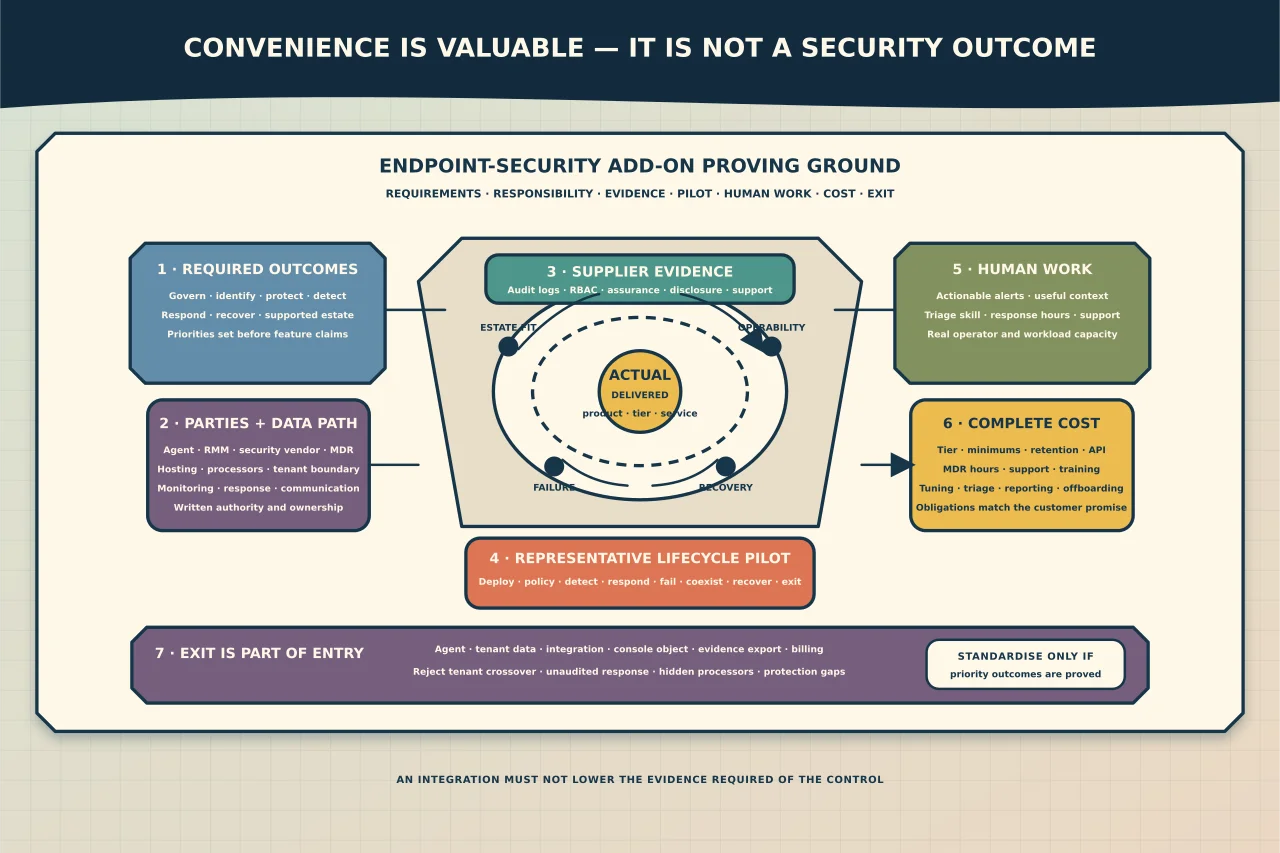
An endpoint-security add-on inside an RMM console can be convenient: one deployment path, one device list and one invoice. Convenience is valuable, but it is not a security outcome.
The bundled product may be a full prevention and response platform, a limited licence tier, a rebranded service or simply a connector to another console. Before standardising it across customers, establish what is actually being sold, who operates it and what happens when something goes wrong.
Start with the outcome, not the badge
Use the organisation’s risks and operating model to define requirements. NIST CSF 2.0 provides a useful outcome vocabulary across Govern, Identify, Protect, Detect, Respond and Recover. Translate that into concrete needs such as:
- supported operating systems and workloads;
- malware and behaviour prevention;
- useful endpoint telemetry and retention;
- detection across relevant attacker behaviours;
- endpoint isolation, process/file response and rollback authority;
- vulnerability or exposure information where promised;
- tamper protection and policy integrity;
- integration with identity, email, SIEM, ticketing and incident response;
- evidence preservation and export; and
- service recovery when the agent or vendor cloud is unavailable.
Prioritise requirements. A tiny office with no internal security operator may need reliable managed detection and response more than a powerful console nobody watches. An MSP with a staffed security team may need raw telemetry, APIs and fine-grained response controls.
Identify the product and every responsible party
Get written answers to these questions:
- Who develops the endpoint agent and detection engine?
- Which exact licence tier and modules does the RMM add-on include?
- Which company hosts telemetry and in which regions?
- Who monitors alerts after hours—the customer, MSP, RMM vendor, security vendor or an MDR partner?
- Who may isolate a device or kill a process, and under what authority?
- Who owns incident communication, evidence and customer notification?
- Which support desk handles an agent that prevents boot or business operation?
Map the data path from endpoint to every RMM, vendor and subcontractor. Review data processing, retention, cross-border transfer, breach notification, deletion and customer-exit commitments. “Integrated” can mean more processors and trust relationships, not fewer.
Demand evidence from the supplier
CISA’s Secure by Demand guidance encourages buyers to require useful security logs and transparent vulnerability handling. Apply that principle to the security product itself.
Ask for:
- customer-visible admin, policy, response and data-access audit logs;
- log retention, export format and API availability without an expensive uplift;
- strong administrator authentication, RBAC and separation between customers;
- a vulnerability-disclosure policy, security advisories and patch lifecycle;
- independent assurance relevant to the delivered service—not a parent-company logo;
- secure update/signing design and a documented agent-failure response;
- incident history and what customers were told; and
- end-of-life, acquisition and service-shutdown commitments.
Treat questionnaires and certifications as evidence inputs, not guarantees. Verify contract wording and test what the console really exposes.
Read independent testing in context
MITRE ATT&CK maps adversary behaviour and ATT&CK Evaluations publish transparent results for selected scenarios and configurations. These resources can reveal whether a product generated useful telemetry, analytic detections and prevention during that evaluation.
They do not prove universal coverage, low false positives, strong support, safe multi-tenancy or suitability for your customers. Confirm which product version, modules, configuration and human service participated. Read the method and detailed results rather than a vendor’s “100%” graphic.
Use several evidence types: transparent adversary emulation, independent prevention tests, your own pilot, vulnerability track record, operator references and support incidents. No single league table should decide the standard.
Design a representative pilot
Create test tenants and choose endpoints that reflect the estate: current and older supported Windows clients, relevant servers, laptops that roam, low-bandwidth sites, line-of-business software and any macOS/Linux coverage being sold.
Establish baseline boot time, CPU, memory, disk, application performance and network usage. Define success thresholds before installing the product.
Test the full lifecycle:
- Deployment: correct tenant, complete coverage, no duplicated devices and visible failures.
- Policy: expected prevention, tamper and update settings arrive and remain applied.
- Detection: harmless authorised simulations produce understandable telemetry and alerts.
- Response: the right operator can isolate and release a device with approvals, audit history and an out-of-band route.
- Noise: routine admin and business activity does not flood the team; exclusions stay narrow.
- Failure: expired licence, disconnected endpoint, stopped sensor, broken upgrade and vendor-cloud outage become visible.
- Coexistence: incumbent protection changes mode through supported vendor designs; there is no accidental gap or two unsupported active engines.
- Recovery: a bad policy or false positive can be reversed safely.
- Exit: the agent, tenant data, integration, console object and billing can all be removed and verified.
Do not test malicious code on a customer device. Use a controlled lab, harmless standard test artefacts and an authorised simulation plan.
Measure the work humans must do
A detection that arrives without user, process tree, device context, recommended action or supporting telemetry creates analyst work rather than reducing risk. During the pilot, measure:
- time from event to alert and triage;
- proportion of actionable versus duplicate/low-value alerts;
- time and skill required to investigate;
- accuracy of device/user/tenant attribution;
- escalation quality from any managed service;
- ability to query history and export evidence; and
- time to obtain competent vendor support.
Run the pilot during ordinary business work so false positives and performance costs are visible. Record who will operate the product after launch and calculate realistic alert volume per technician.
Model the complete commercial cost
Compare like with like: licence tier, minimum quantities, server and workstation rates, MDR coverage hours, data retention, API/export, incident assistance, training, onboarding, support, currency movement and annual increases.
Include internal labour for tuning, triage, reporting, false positives, upgrades and offboarding. A low unit price can become expensive if every alert needs manual reconstruction or the MSP silently accepts 24/7 response obligations.
Define which service is included in the customer agreement and which needs separate incident-response authority. Do not market “managed security” when nobody is accountable for continuous monitoring or response.
Use explicit acceptance and exit criteria
Standardise only when the pilot proves the priority outcomes across representative devices and the contract matches the operating model. Record known coverage gaps and compensating controls.
Also pre-approve rejection criteria: unsafe tenant crossover, unexplained agent failure, unreliable telemetry, unacceptable performance, unaudited response actions, missing export, unresolved privacy terms, weak support or an impractical uninstall path.
An RMM integration should reduce deployment and operational friction. It should never lower the evidence required to trust the security control beneath it.