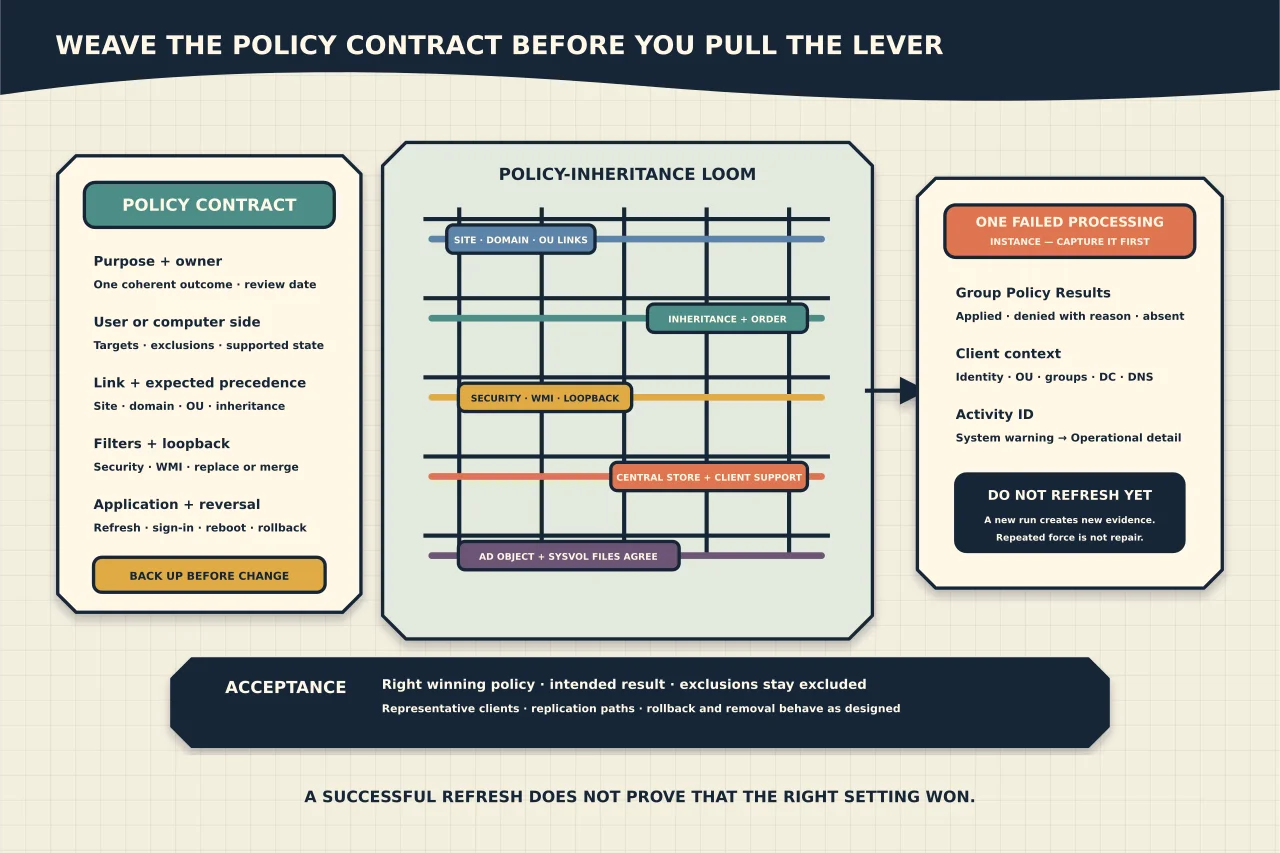
Group Policy is predictable when its inputs are visible: computer/user location, links, inheritance, filters, loopback, templates, replication and client-side processing. It feels mysterious when administrators change several of those inputs and then run gpupdate /force until the symptom moves.
Write the policy contract
Before creating a GPO, record:
- reader/business outcome and setting;
- computer or user side;
- target and explicit exclusions;
- supported Windows/application versions;
- link location and expected precedence;
- security/WMI filter rationale;
- refresh/reboot/sign-in requirement;
- telemetry and rollback; and
- owner/review date.
Prefer one coherent purpose per GPO. Avoid monolithic “all settings” objects and a proliferation of single-setting GPOs with no ownership.
Understand effective scope
Policy processes according to site, domain and OU links plus inheritance/order/enforcement. Security filtering decides which principals may apply it; WMI filters evaluate device state; loopback can replace or merge user policy based on the computer.
Delegation to edit a GPO is separate from the right to link it. Keep production linking and broad security settings tightly controlled.
Preferences can create/configure convenient items such as drives, but they are not enforcement and policy settings take precedence where they conflict. Understand Create/Replace/Update/Delete semantics before rollout.
Control templates and replication
Back up the GPO before change. Record the Central Store/ADMX version used, especially for newer Windows or application settings. An editor can show a setting that older clients ignore or whose accompanying ADML is missing.
Confirm AD replication of the GPO object and DFSR replication of its SYSVOL files. Matching version numbers with missing/different files is not healthy policy.
Model, pilot, stage
Use Group Policy Modeling for planned scope and Group Policy Results/gpresult for actual clients. Pilot with representative devices/users, including slow/remote links and exclusions. Use an allowlisted pilot group or OU whose lifecycle is clear.
Test initial application, background refresh, sign-in/reboot if required, removal/rollback and offline/failure behaviour. Expand only after measured results.
Diagnose one affected processing instance
On the affected client capture:
gpresult /h <evidence-file>.htmlCheck whether the GPO is applied, denied and why, or absent. Confirm client identity, OU, groups, DC used, network and DNS.
Find the relevant Group Policy warning/error in the System log and its Activity ID, then filter the GroupPolicy Operational log to that same processing instance. Microsoft notes that another refresh creates a new Activity ID—preserve the failed one before gpupdate.
Route the finding:
- absent GPO: link/scope/inheritance/replication;
- denied security: permissions/group token/filter;
- WMI failure/slow: query/provider/target state;
- file/path error: SYSVOL/network/DNS/client-side extension;
- setting applied but ineffective: precedence, application/OS support or restart; or
- preference removed/recreated item: action semantics and item-level targeting.
Change one proven cause
Do not unlink a domain-wide GPO because one device says denied; denial may be correct. Do not delete local registry state before identifying the winning policy. Do not use repeated /force as a repair—it reprocesses policy and changes evidence.
Correct the smallest source of truth: link/filter, group membership, WMI query, template, SYSVOL/AD replication or client-side dependency. Then generate a new processing instance and compare.
Verify intended and unintended outcomes
Confirm the setting on pilot targets and absence on exclusions. Check RSoP winning GPO, registry/application behaviour, events, restart/sign-in persistence and rollback/removal semantics. Repeat from multiple sites/DCs after replication.
A successful gpupdate means processing completed; it does not prove the intended setting won. Policy acceptance requires the right outcome on the right devices, predictable exclusion and a tested reversal.