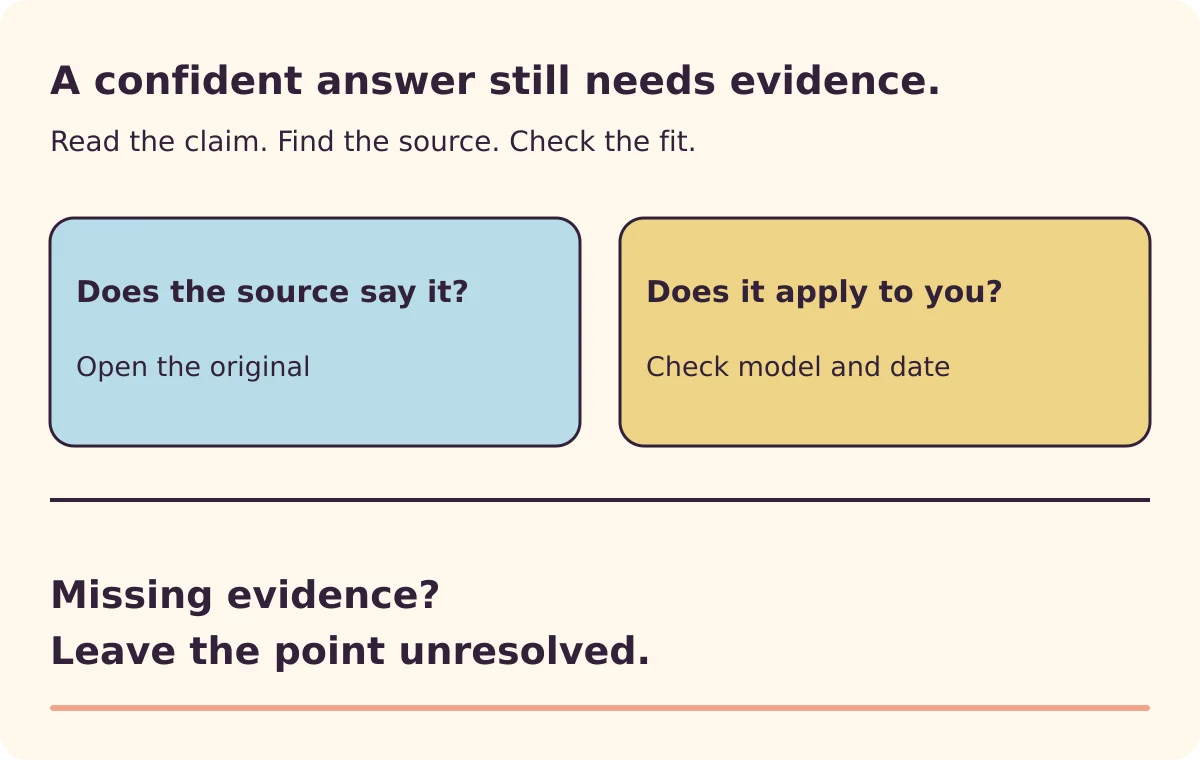
An AI assistant can produce a convincing explanation and still invent a reference, miss a condition or give the wrong date. This is often called a hallucination. The important question for a reader is whether a statement has evidence behind it.
You can still use AI to explore ideas, organise information and make unfamiliar material easier to approach. The skill is knowing which parts of its answer to verify before relying on them.
Fluent language and factual accuracy are different things
Large language models generate text using patterns learned during training and the context supplied to them. Producing a plausible next part of an answer does not, by itself, establish that the statement is true.
NIST describes this problem as confabulation: output that can sound confident while being false, inconsistent or at odds with the supplied information. Its Generative AI Profile, section 2.2, connects the problem to the statistical generation process.
A useful way to read an AI answer is to separate its explanation from its evidence. A clear paragraph may help you understand a topic. A claim about a product’s current limit still needs a current source.
Watch for the small error that changes the decision
Consider these deliberately invented teaching examples:
| Plausible answer | What could be wrong |
|---|---|
| “This laptop supports a memory upgrade.” | A different configuration may have soldered memory. |
| “The workshop is free and laptops are available.” | Borrowing a laptop may require advance booking. |
| “The report shows a 20% improvement.” | It may mean 20 percentage points, or describe only one group. |
| “The feature is included in the plan.” | The source may describe another account tier or an old offer. |
These examples are not recorded failures from named AI products. They illustrate why a mostly sensible answer can still lead to the wrong action.
An error does not have to look bizarre. The sentence you are most likely to overlook may be the one containing a model number, exception or unit.
Choose what needs checking
For brainstorming a party theme, the main test may be whether an idea suits you. For choosing a replacement computer part, the exact model and compatibility are essential.
Before using an answer, identify the facts that would change what you do:
- The exact item, version or account involved.
- Dates and statements about current availability.
- Measurements, prices, quantities and units.
- Requirements and exceptions.
- Any instruction that changes or deletes something.
This is an editorial checking method, not a numerical reliability score. You do not need to investigate every harmless turn of phrase equally.
Open the source and match the claim
If an answer supplies a link, open it. Check that it is the expected publisher and that the page actually supports the sentence.
For the laptop example, a manufacturer page about a whole product family may not answer the question about your exact configuration. Find the relevant specification or service manual. If that evidence is missing, the upgrade question remains open.
For a quotation, locate the words in the original and read the surrounding paragraph. For a number, verify what was measured and recalculate simple arithmetic separately. For a dated rule or product feature, inspect whether the source still applies.
A source link is a route to verification. Its presence beside a sentence is not the verification itself.
Ask for uncertainty instead of forced completeness
A useful follow-up is:
Separate facts supported by the source from your interpretation. Identify missing information. For each fact that affects the recommendation, show me where I can verify it. Leave unresolved points unresolved.
Anthropic’s guidance recommends allowing uncertainty and grounding claims in sources. It also states that mitigation does not eliminate hallucinations.
Be cautious about turning “Are you sure?” into your entire checking process. A second confident answer is another claim. It becomes useful when it directs you to evidence you can examine.
Correct the result where you will use it
If you find a mistake, fix the saved notes, message or document that will inform your decision. Correcting the chat while leaving the wrong figure in your working document does not solve the practical problem.
Keep unresolved claims visibly separate from verified ones. If a critical fact cannot be checked, postpone that part of the decision or ask someone qualified to establish it.
For a complete example of using this approach on a document, follow the checked PDF-summary workflow. The aim is a useful answer whose important claims you can explain and support.